
Imagine being able to inspect a machine, building, vehicle or even an entire city without physically touching it.
You could monitor its condition, test possible changes, identify developing problems and predict how it might behave in the future—all through a digital representation.
That is the basic idea behind digital twin technology.
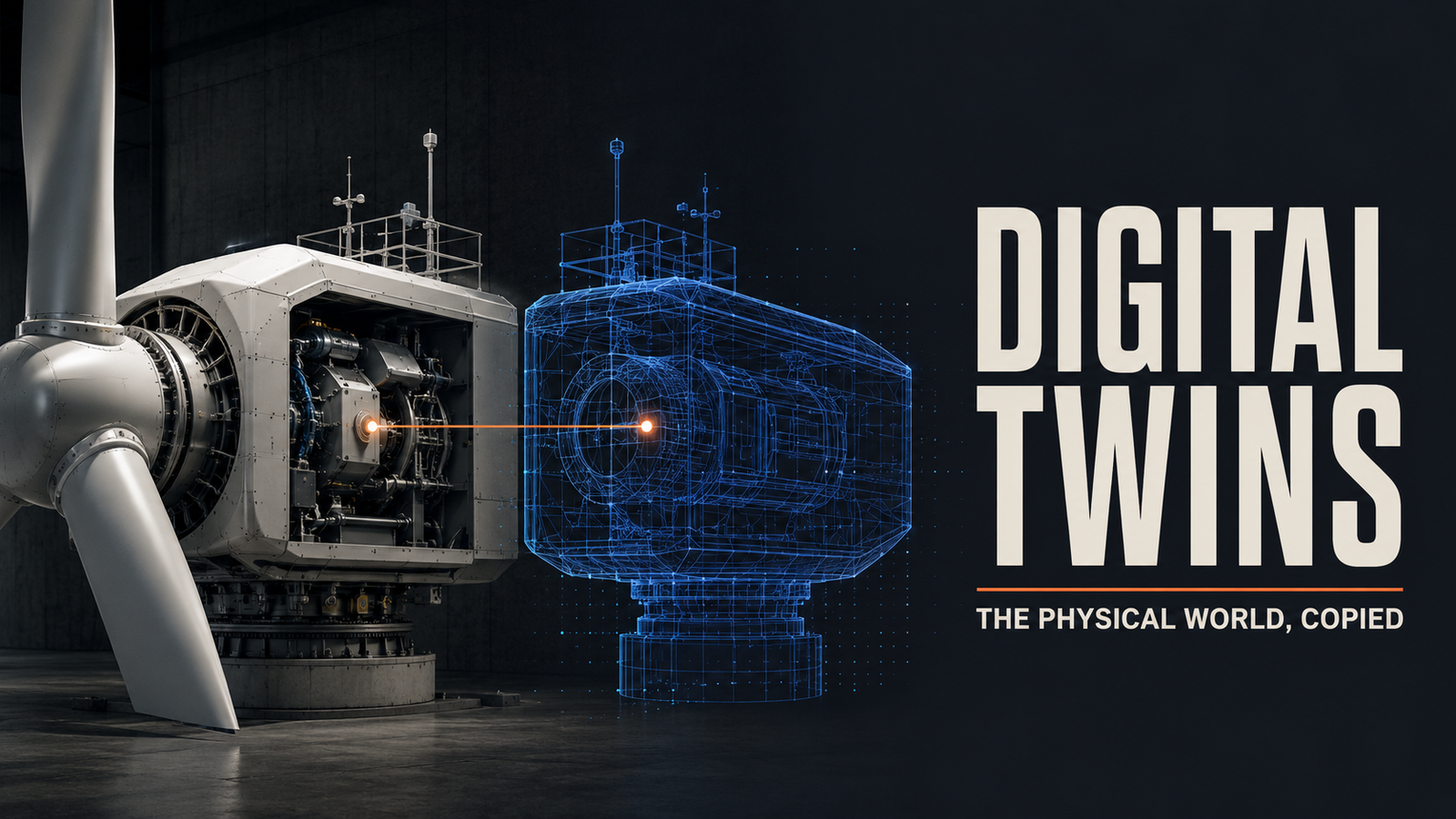
A digital twin is more than a three-dimensional model. It is a virtual representation connected to its physical counterpart through real-world data. Sensors and software continuously update the digital version so that it reflects the condition and behaviour of the actual object or system.
Businesses can use this virtual counterpart to understand performance, test decisions and detect problems before making expensive changes in the real world.
Digital twins are already used in manufacturing, energy, transportation, healthcare, construction and urban planning. As connected devices, cloud platforms and artificial intelligence become more capable, digital twins are likely to become an increasingly important part of how organisations operate physical systems.
What Is a Digital Twin?
A digital twin is a virtual representation of a physical object, process, environment or system that is updated using real-world data.
The physical subject could be something relatively small, such as an engine component, or something much larger, such as:
- A manufacturing plant
- A commercial building
- A wind turbine
- A railway network
- An aircraft engine
- A hospital
- A supply chain
- An entire city
Sensors installed on the physical system collect information about its condition and performance. That information is transmitted to the digital twin, where software can organise, visualise and analyse it.
For example, a digital twin of an industrial machine might receive data about temperature, vibration, pressure, energy consumption and operating speed.
Engineers can study the virtual model to understand how the physical machine is performing without stopping production or physically inspecting every component.
How Does a Digital Twin Work?
A digital twin system generally connects four major elements: the physical object, data collection technology, a virtual model and an analysis platform.
1. The Physical Object or System
The process begins with something that exists in the real world.
It could be a machine, vehicle, building, product, production line or infrastructure network. The digital twin is created to represent the important characteristics and behaviour of this physical system.
2. Sensors and Connected Devices
Sensors collect information from the physical object.
Depending on the application, they might measure:
- Temperature
- Pressure
- Movement
- Vibration
- Humidity
- Energy consumption
- Speed
- Location
- Structural stress
- Air quality
- Equipment output
Connected devices transfer this information to the software environment containing the digital twin.
3. The Virtual Model
The virtual model represents the structure, condition and behaviour of the physical subject.
It may include a detailed three-dimensional model, although a 3D visualisation is not always necessary. Some digital twins are primarily made from data models, process diagrams, calculations and performance dashboards.
The important feature is not how the twin looks. It is how accurately it represents the real system.
4. Data Processing and Analysis
Software processes the incoming information and updates the digital representation.
Engineers, managers and analysts can use the twin to observe performance, compare current data with expected behaviour, identify unusual patterns and test different scenarios.
Machine learning and artificial intelligence can also help find relationships in the data or predict future outcomes.
5. Decisions and Real-World Action
The insights produced by a digital twin can lead to actions in the physical world.
A company might repair a machine, adjust production settings, change a building’s cooling system or reroute vehicles based on what the digital twin reveals.
In advanced systems, some adjustments may be performed automatically.
A Simple Digital Twin Example
Consider a wind turbine located in a remote wind farm.
Sensors inside the turbine monitor wind speed, blade movement, temperature, vibration, energy production and the condition of mechanical components. This information is continuously sent to its digital twin.
The virtual model allows engineers to monitor the turbine remotely. If its vibration begins to move outside the normal range, the system may identify a possible bearing problem.
The operator can schedule maintenance before the component fails.
Engineers may also use the digital twin to test how different blade angles or operating conditions could affect energy production. They can explore the possible results digitally before making changes to the actual turbine.
This can reduce downtime, improve performance and prevent unnecessary maintenance.
Digital Twin vs Simulation
Digital twins and simulations are related, but they are not the same.
A simulation is normally created to study how a system might behave under a specific set of conditions. It may be based on historical data, assumptions or mathematical rules.
A digital twin is connected to a particular physical object or system and regularly updated with real-world information.
| Feature | Digital Twin | Traditional Simulation |
|---|---|---|
| Connection to physical system | Connected through ongoing data | Often operates independently |
| Data updates | Regular or real-time updates | Usually based on predefined inputs |
| Main purpose | Monitor, analyse and improve a real system | Test a specific scenario or concept |
| Lifespan | May exist throughout an asset’s lifecycle | Often created for a particular analysis |
| Feedback | Can influence real-world operations | Usually produces results for review |
A digital twin may contain simulation capabilities. However, the connection with its physical counterpart is what makes it a digital twin.
Types of Digital Twins
Digital twins can represent different levels of a system.
Component Twins
A component twin represents an individual part of a larger product or machine.
For example, a manufacturer could create a digital twin of a motor, battery, pump or turbine blade. The twin helps monitor how that component performs under real operating conditions.
Asset Twins
An asset twin represents a complete piece of equipment made from multiple components.
A digital twin of an aircraft engine, for example, may combine data from several internal components to provide an overall view of engine health and performance.
System Twins
A system twin represents several connected assets working together.
A factory production line is one example. The twin may show how machines, workers, materials and software interact throughout the production process.
Process Twins
A process twin represents a larger workflow or operation.
It could model a complete supply chain, hospital process, transport network or manufacturing operation. This allows organisations to understand how decisions in one area affect the entire system.
Benefits of Digital Twin Technology
Digital twins can provide practical advantages throughout the lifecycle of a product, asset or process.
Predictive Maintenance
Traditional maintenance may be performed according to a fixed schedule, whether equipment needs attention or not. Alternatively, a business may wait until something breaks.
Digital twins make condition-based and predictive maintenance possible.
By monitoring equipment data, the system can identify signs of wear or abnormal behaviour. Maintenance can then be scheduled when it is genuinely needed and before a major failure occurs.
Reduced Downtime
Unexpected equipment failure can interrupt production and create substantial costs.
A digital twin gives teams greater visibility into the condition of important assets. Early warnings allow them to prepare replacement parts, schedule technicians and perform repairs during planned maintenance periods.
Better Product Design
Engineers can use digital twins to understand how products behave after they enter the real world.
Instead of relying only on laboratory testing, manufacturers can study information from products operating under different conditions. These insights can guide future designs and improve existing models.
Safer Testing
Some experiments are too dangerous, expensive or disruptive to conduct on physical systems.
A digital twin allows teams to explore possible scenarios virtually. Engineers could examine how equipment might respond to extreme temperatures, increased pressure, unusual workloads or component failure.
The results can help them prepare without exposing people or equipment to unnecessary risk.
Improved Efficiency
Digital twins can show where energy, materials, time or other resources are being wasted.
A building operator might discover that certain areas are being cooled when they are empty. A factory might identify a bottleneck reducing output. A logistics company may find a more efficient route for vehicles.
Remote Monitoring
Digital twins enable experts to inspect systems without always being physically present.
This is particularly valuable for offshore equipment, remote energy facilities, mines, industrial plants and infrastructure distributed across large areas.
More Informed Decisions
A digital twin provides a central view of the information surrounding an asset or process.
Instead of making decisions based on assumptions or disconnected reports, teams can examine current operating data, historical patterns and possible future scenarios.
Real-World Applications of Digital Twins
Digital twin technology can be used wherever physical assets or complex processes generate useful data.
Manufacturing
Manufacturers use digital twins to monitor machines, production lines and factories.
A digital twin can help identify equipment problems, reduce downtime, optimise production settings and understand how changes may affect output.
Manufacturers may also create twins of products to follow their performance from initial design through production and real-world use.
Healthcare
Digital twins can represent medical equipment, hospital operations or aspects of a patient’s condition.
A hospital might create a process twin to examine patient movement, bed availability, staffing and equipment usage. This can help administrators understand where delays occur.
Medical researchers may also use virtual models to explore how treatments or devices could behave, although human health applications require strong privacy, accuracy and professional oversight.
Buildings and Construction
Architects, engineers and facility managers can use digital twins throughout a building’s lifecycle.
During planning, a twin can support design and construction decisions. After the building opens, information from lighting, elevators, heating, ventilation, air conditioning and occupancy sensors can update the model.
Facility managers can then monitor energy usage, maintenance requirements and space utilisation.
Transportation
Digital twins can represent individual vehicles, railway systems, airports, roads or complete transportation networks.
A fleet operator might monitor the health and location of vehicles. A railway operator could use a digital twin to examine track conditions, train movements and maintenance requirements.
Transport planners can also test how route changes or increased demand may affect a network.
Energy and Utilities
Energy companies manage equipment spread across power plants, wind farms, solar facilities and electrical networks.
Digital twins can help monitor this infrastructure, predict equipment problems and improve energy distribution. They can also support the integration of changing energy sources into the grid.
Smart Cities
A city-level digital twin may combine information about traffic, buildings, public transport, pollution, energy use and infrastructure.
Urban planners can use this virtual environment to explore the possible effects of new roads, construction projects, transport policies or emergency plans.
A city is extremely complex, so its digital twin may represent only selected systems rather than reproducing every detail.
Retail and Supply Chains
Retailers and logistics companies can use digital twins to model warehouses, inventory movement and supply chains.
The virtual model can help teams study delivery delays, warehouse capacity, stock availability and the effect of disruptions.
The Role of Artificial Intelligence in Digital Twins
Artificial intelligence can make digital twins more useful by analysing large volumes of information.
A digital twin may collect more data than a person can review manually. Machine-learning systems can detect unusual patterns, compare current behaviour with historical performance and estimate what may happen next.
For example, an AI system could analyse vibration data from hundreds of machines and identify the signals most closely associated with failure.
Artificial intelligence can also help digital twins recommend actions or automatically adjust connected systems.
However, an AI prediction is only as reliable as the information and assumptions supporting it. Human review remains important, particularly when decisions involve safety, health or critical infrastructure.
Challenges and Limitations of Digital Twins
Creating a useful digital twin requires more than building an attractive 3D model.
Data Quality
A digital twin depends on accurate information. Faulty sensors, missing records or inconsistent data can produce misleading results.
Implementation Cost
Sensors, connectivity, software, computing infrastructure and specialised expertise can require substantial investment.
A business must identify a clear use case rather than creating a digital twin simply because the technology is available.
Integration Problems
Older equipment may not have modern sensors or compatible software. Connecting data from different systems can be technically difficult.
Cybersecurity Risks
Digital twins may contain sensitive operational information. If connected to physical equipment, an insecure system could create risks beyond the loss of data.
Businesses need encryption, access controls, secure devices and regular security monitoring.
Model Accuracy
A digital twin cannot perfectly reproduce every detail of the physical world. Teams must decide which factors are important and how accurately they need to be represented.
An incomplete model may still be useful, but its limitations should be clearly understood.
Data Ownership and Privacy
Digital twins involving buildings, vehicles, employees, customers or patients may collect personal or commercially sensitive information.
Organisations must decide who owns the data, who can access it and how long it should be stored.
Is a Digital Twin the Same as the Metaverse?
A digital twin and the metaverse are different concepts.
A digital twin is designed to represent and analyse a real physical object or system. Its main value comes from its connection to real-world data.
The metaverse generally refers to shared digital environments where people can interact through virtual or augmented experiences.
A digital twin can appear inside an immersive virtual environment, but it does not require virtual reality or a metaverse platform.
How Businesses Can Get Started With Digital Twins
An organisation should begin with a specific operational problem.
Rather than attempting to model an entire company, it may be better to focus on one valuable asset or process.
A practical starting approach could include:
- Identify a costly or important operational problem.
- Select the asset or process that should be represented.
- Determine which data is required.
- Review whether reliable sensors and systems already exist.
- Build a limited digital model.
- Test whether the twin produces useful insights.
- Measure its effect on cost, downtime, safety or performance.
- Expand the system only after demonstrating value.
The goal should not be to create the most detailed virtual model possible. The goal should be to create a useful representation that supports better decisions.
Frequently Asked Questions About Digital Twins
What is a digital twin in simple terms?
A digital twin is a virtual version of a real object, system or process that is updated using information from its physical counterpart.
What is an example of a digital twin?
A virtual model of a wind turbine that receives live information about vibration, temperature and energy production is an example of a digital twin.
Does a digital twin need to be a 3D model?
No. A digital twin may include a 3D model, but it can also use dashboards, data models, diagrams and analytical tools.
Is digital twin technology part of the Internet of Things?
The technologies are closely connected. Internet of Things devices and sensors often collect the data used to update a digital twin.
Do digital twins use artificial intelligence?
Some digital twins use artificial intelligence for predictions, pattern detection and automated recommendations. AI is useful but not required for every digital twin.
Are digital twins used only in manufacturing?
No. They are also used in healthcare, energy, transportation, construction, retail, logistics and urban planning.
What is the biggest advantage of a digital twin?
Its main advantage is that it allows people to monitor and analyse a physical system without relying entirely on direct inspection or disruptive real-world testing.
Final Thoughts
Digital twin technology creates a bridge between physical systems and digital intelligence.
By combining sensors, connected devices, virtual models and data analysis, a digital twin can reveal how an object or process is performing in the real world. It can help organisations identify problems earlier, test decisions more safely and use resources more efficiently.
The technology is not valuable simply because it creates a digital copy. Its value comes from the decisions that the copy helps people make.
A carefully designed digital twin can reduce downtime, improve products, support safer operations and provide a clearer understanding of complex systems.
As physical infrastructure becomes more connected, digital twins will likely become an essential tool for managing machines, buildings, transport networks and other systems that shape everyday life.