
Artificial intelligence depends on data.
A self-driving system needs examples of roads, vehicles and pedestrians. A fraud-detection model needs transaction patterns. Medical software may require images showing different health conditions.
Collecting enough real-world data for these systems can be expensive, slow and sometimes dangerous. The information may also contain personal or commercially sensitive details that cannot be freely shared.
Some situations are simply too rare to appear often enough in a real dataset. An autonomous vehicle may need to recognise an unusual accident, but waiting for thousands of genuine examples would be impractical and unsafe.
Synthetic data provides another option.
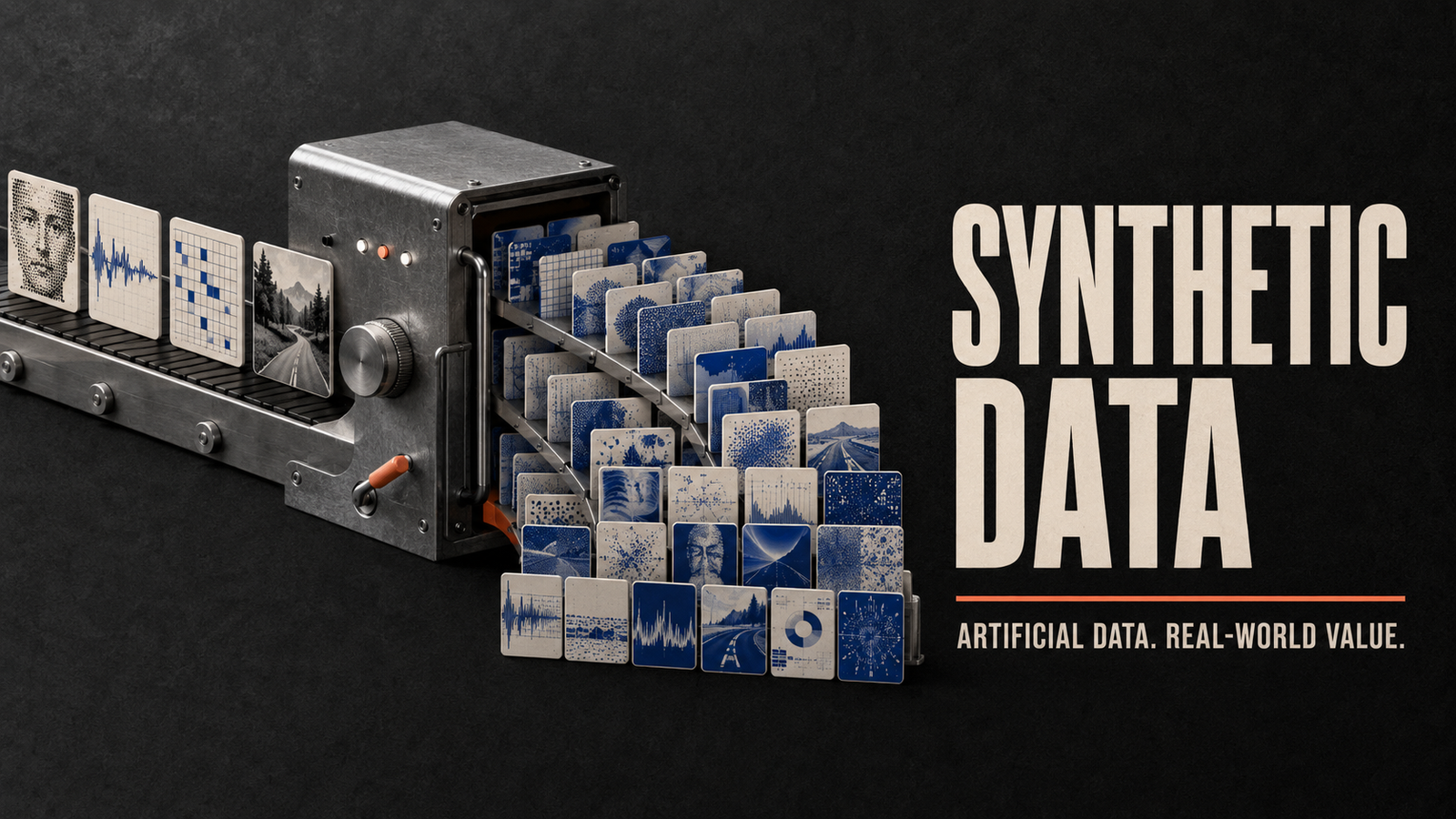
Synthetic data is artificially generated information designed to reproduce useful patterns or characteristics of real-world data. It can supplement existing datasets, create examples of rare situations, support software testing and reduce direct exposure to sensitive records.
However, artificial data is not automatically accurate, private or unbiased. Its value depends on how it is generated, evaluated and used.
What Is Synthetic Data?
Synthetic data is information created through computer models, algorithms, rules or simulations rather than collected directly from events in the physical world.
It may resemble real data without representing actual people, transactions or situations.
Synthetic data can take many forms, including:
- Tables and spreadsheets
- Images
- Videos
- Audio recordings
- Written text
- Medical records
- Financial transactions
- Sensor readings
- Customer behaviour
- Geographic information
- Three-dimensional environments
For example, a synthetic medical dataset might contain fictional patient profiles with realistic relationships between age, blood pressure, symptoms and treatment outcomes.
The records do not belong to real patients, but the dataset attempts to preserve the statistical patterns required for analysis or model training.
How Is Synthetic Data Created?
There is no single method for generating synthetic data. The right approach depends on the type of information and its intended use.
Rule-Based Generation
Developers can create data using predefined rules.
A testing system for an online store might generate fictional customers with names, addresses, order amounts and payment statuses. Rules ensure that dates use the correct format and order totals fall within an expected range.
Rule-based generation is easy to control, but it may not reproduce the complexity of genuine human behaviour.
Statistical Models
A statistical model studies distributions and relationships within a real dataset.
It can then generate new values with similar characteristics.
If real customer ages follow a particular distribution and spending tends to increase within certain age groups, the synthetic dataset can attempt to preserve these relationships.
Simulations
Simulations use mathematical or physical rules to model real-world environments.
Engineers can simulate traffic, weather, machine performance, wireless networks or the movement of objects. The simulated environment produces sensor readings, images and events that can be used as synthetic data.
Generative Artificial Intelligence
Generative models can learn patterns from existing data and create new examples.
Depending on the application, these systems may generate:
- Realistic images
- Artificial voices
- Written conversations
- Tabular business records
- Medical scans
- Three-dimensional scenes
Generated examples should be evaluated carefully to ensure that they are sufficiently realistic without copying sensitive records.
Digital Twins
A digital twin is a virtual representation of a physical object or system that receives real-world data.
It can be used to simulate different conditions and generate artificial information about how the physical system might respond.
For example, a digital twin of a factory could produce synthetic sensor data for equipment failures that have not yet occurred.
Data Augmentation
Data augmentation modifies existing examples to create additional training data.
An image can be rotated, cropped, brightened or partially covered. An audio sample may receive added background noise or a small change in speed.
Augmented data remains closely connected to real observations, but it increases variety without requiring completely new collection.
A Simple Synthetic Data Example
Imagine a bank developing a system to detect payment fraud.
The bank has millions of normal transactions but relatively few confirmed fraudulent examples. This creates an imbalanced dataset.
A model trained on that information might become good at recognising ordinary payments while missing rare fraud patterns.
The bank could generate synthetic fraudulent transactions with realistic combinations of amount, time, location, device and spending behaviour.
These artificial examples can help the model learn a wider variety of suspicious patterns.
The bank must still test the final model on carefully protected real-world data. If the synthetic examples do not accurately represent genuine fraud, they may create a false sense of performance.
Synthetic Data vs Real Data
Synthetic data and real data serve different purposes.
| Feature | Synthetic Data | Real Data |
|---|---|---|
| Source | Generated by software or simulations | Collected from real events |
| Connection to actual people | May represent fictional individuals | May contain identifiable information |
| Collection cost | Can be lower after setup | Can require substantial collection effort |
| Rare situations | Can be generated intentionally | May be difficult to capture |
| Control | Developers can adjust conditions | Conditions depend on reality |
| Realism | Depends on the generation method | Reflects genuine behaviour |
| Bias | Can inherit or introduce bias | Can contain historical and sampling bias |
| Privacy | May reduce direct exposure | Often requires strict protection |
| Validation | Must be compared with reality | Serves as the real-world reference |
Synthetic data should not always replace real data.
It is often most valuable when combined with genuine observations. Real data provides grounding, while synthetic data increases coverage, balance or accessibility.
Why Is Synthetic Data Important for AI?
AI models often require large and diverse training datasets.
Real-world data may be difficult to obtain because it is:
- Private
- Expensive
- Poorly labelled
- Incomplete
- Legally restricted
- Commercially sensitive
- Rare
- Dangerous to collect
- Controlled by another organisation
Synthetic data can help address some of these limitations.
A development team can generate specific examples, control the balance of its dataset and test conditions that have not occurred frequently in real life.
This does not eliminate the need for real-world evaluation. A model that performs well only on synthetic data may fail when exposed to actual users or environments.
Benefits of Synthetic Data
Synthetic data can offer several practical advantages.
Reduced Exposure to Sensitive Information
Artificial records may allow teams to work without giving every developer access to real customer or patient information.
This can reduce privacy risks, but only when the generation method prevents sensitive records from being reproduced or inferred.
More Examples of Rare Events
Some of the most important situations are also the least common.
Autonomous systems must recognise unusual road hazards. Cybersecurity tools need examples of emerging attacks. Medical models may need information about uncommon conditions.
Synthetic data can intentionally create these cases.
Balanced Training Datasets
Real datasets often contain many examples from common groups and very few from others.
Synthetic data can add examples to underrepresented categories. This may help improve model performance, although artificial balancing does not guarantee fairness.
Faster Data Creation
Collecting real information can take months or years.
Once a suitable generator or simulation has been developed, teams can create additional examples more quickly.
Controlled Conditions
Researchers can change one variable at a time.
A vehicle simulation could test the same road under rain, fog, darkness and bright sunlight. This makes it easier to understand how individual conditions affect a model.
Automatic Labels
Training data often needs labels explaining what each example contains.
A simulation already knows the location, category and properties of every generated object. It can therefore create labels automatically.
Safer Testing
Some situations would be dangerous or unethical to create in real life.
Synthetic environments allow teams to test accidents, equipment failures and emergency scenarios without placing people at risk.
Better Software Testing
Developers need data to test whether applications handle different inputs correctly.
Synthetic records can include unusual names, missing fields, extremely large transactions or other edge cases without using real customer information.
Real-World Applications of Synthetic Data
Synthetic data can support many industries and technologies.
Autonomous Vehicles
Collecting road data for every possible condition is nearly impossible.
Simulated environments can generate pedestrians, vehicles, animals, construction zones, poor weather and unexpected hazards.
Developers can use these scenarios to train and evaluate perception systems before testing them on public roads.
Healthcare
Medical data is highly sensitive and may be difficult to share.
Synthetic patient records and images can support software development, research and training while reducing direct access to real patient information.
Medical applications require careful expert validation. Artificial data may overlook important biological patterns or produce unrealistic cases.
Financial Services
Banks and payment providers can generate synthetic transactions for fraud detection, risk modelling and software testing.
These datasets can include unusual behaviour without revealing complete customer histories.
Cybersecurity
Security teams can create artificial network traffic, malware behaviour and attack scenarios.
Synthetic events help train detection systems and test how security tools respond to known and hypothetical threats.
Manufacturing
Factories can simulate sensor readings, production defects and machine failures.
This allows maintenance and quality-control systems to learn from events that happen infrequently.
Retail
Retailers can generate artificial purchasing histories, inventory patterns and customer journeys.
Synthetic data can help test recommendation systems, demand forecasts and store operations.
Telecommunications
Network operators can simulate traffic, outages, congestion and user movement.
These datasets can support network planning and fault-detection models.
Robotics
Robots need large numbers of examples to navigate and interact with objects.
Simulation environments allow robots to practise tasks before operating in real factories, warehouses or homes.
Software Development
Development teams can create artificial customer accounts, transactions and application events.
This helps them test systems without copying production databases into less secure development environments.
Is Synthetic Data Truly Anonymous?
Synthetic data is sometimes described as anonymous because it does not necessarily represent real individuals.
However, artificial data is not automatically private.
A generative model trained incorrectly might reproduce parts of its original dataset. A synthetic record could closely resemble a real person, particularly when the source dataset is small.
Attackers may also use statistical techniques to infer whether certain records influenced the generator.
Privacy protection therefore requires more than removing names.
Organisations should evaluate:
- Similarity between synthetic and real records
- Whether individual source records can be reconstructed
- Whether rare combinations reveal identities
- How the generator was trained
- Who can access the source data
- Whether privacy-preserving methods were used
- Whether the synthetic data retains unnecessary sensitive attributes
Synthetic data should go through formal privacy testing before being shared or treated as safe.
Can Synthetic Data Be Biased?
Yes.
If the real dataset contains bias, a synthetic generator may reproduce it. The generator may also exaggerate some patterns or remove important differences.
For example, if a medical dataset underrepresents a population, generating more records from the same distribution will not automatically solve the problem. It may simply create more artificial examples of the existing imbalance.
Teams must evaluate performance across relevant populations, environments and scenarios.
Synthetic data can help create underrepresented examples, but experts must verify that those examples are realistic.
Challenges and Limitations of Synthetic Data
Synthetic data introduces several risks.
The Reality Gap
Artificial data may not capture the full complexity of real environments.
A model can perform well in simulation and fail in reality because of details the generator did not reproduce.
Quality Measurement
It can be difficult to determine whether synthetic data is “good.”
A dataset might look realistic while missing the relationships most important for a particular task.
Hidden Bias
Synthetic generators can preserve bias from source data or introduce new bias through modelling assumptions.
Privacy Leakage
Poorly designed systems may memorise and reproduce sensitive information.
Model Collapse
If future AI systems are repeatedly trained on low-quality artificial content, errors and reduced diversity may accumulate.
High-quality real-world information remains important for grounding and evaluation.
Overconfidence
Large amounts of synthetic data can create impressive performance within artificial tests.
That performance may not translate to real users, devices or environments.
Technical Cost
Building an accurate simulator or generator may require substantial expertise, computing resources and domain knowledge.
Synthetic data is not always cheaper than collecting real data.
How to Evaluate Synthetic Data
A useful synthetic dataset should be tested across several dimensions.
Statistical Similarity
Do important distributions and relationships resemble the real dataset?
Matching individual averages is not enough if correlations and rare patterns are missing.
Task Performance
Does a model trained with synthetic data perform well on protected, representative real-world test data?
This is often more meaningful than visual similarity alone.
Diversity
Does the dataset include a wide range of realistic examples, or does it repeatedly generate similar records?
Privacy
Can attackers infer source records or identify individuals from the generated data?
Fairness
Does the dataset represent relevant groups and conditions appropriately?
Domain Validity
Do experts consider the generated examples realistic and useful?
A medically plausible record, for instance, requires more than statistical similarity. Clinical relationships must also make sense.
Best Practices for Using Synthetic Data
Organisations can reduce risk by following a structured process:
- Define the exact problem synthetic data should solve.
- Use reliable and legally obtained source information.
- Involve experts who understand the real-world domain.
- Keep genuine validation data separate.
- Measure privacy instead of assuming anonymity.
- Test models on representative real-world cases.
- Evaluate bias across important groups.
- Document how the data was generated.
- Monitor performance after deployment.
- Update the generator when real conditions change.
Synthetic data should support good data governance, not bypass it.
Will Synthetic Data Replace Real Data?
Synthetic data is unlikely to remove the need for real-world information.
Artificial data needs some understanding of reality. Models, rules and simulations must be designed or calibrated using genuine observations and expert knowledge.
Real data is also necessary for final evaluation. Without it, teams may not recognise where synthetic examples fail to represent actual conditions.
The more practical future is a combination:
- Real data provides accuracy and grounding.
- Synthetic data adds scale and variety.
- Simulation covers rare or dangerous situations.
- Privacy techniques reduce exposure.
- Human experts validate whether the information makes sense.
Frequently Asked Questions About Synthetic Data
What is synthetic data in simple terms?
Synthetic data is artificially generated information designed to imitate useful patterns found in real-world data.
Is synthetic data fake data?
It is artificial, but “fake” can be misleading. Well-designed synthetic data can preserve realistic relationships and be useful for training, testing and analysis.
How is synthetic data generated?
It can be created through rules, statistical models, simulations, data augmentation and generative artificial intelligence.
Is synthetic data safe to share?
Not automatically. It should be tested for privacy leakage and similarity to sensitive source records before being shared.
Can synthetic data train AI models?
Yes. It can supplement or sometimes replace portions of a training dataset. Models should still be evaluated using representative real-world information.
What is an example of synthetic data?
Computer-generated images of road conditions used to train an autonomous-vehicle system are one example.
What is the main disadvantage of synthetic data?
Its biggest limitation is the reality gap. Artificial examples may fail to capture important details and behaviour found in the real world.
Is data augmentation synthetic data?
Data augmentation is commonly considered a form of synthetic data creation because it generates new training examples by transforming existing ones.
Final Thoughts
Synthetic data offers a practical way to create information when real data is limited, sensitive, expensive or dangerous to collect.
It can help developers train AI systems, test software, balance datasets and explore rare situations. Its applications extend from healthcare and finance to autonomous vehicles, robotics, manufacturing and cybersecurity.
However, synthetic does not automatically mean accurate, private or unbiased.
Artificial datasets can reproduce source-data problems, expose sensitive information or create models that perform well only in simulations.
The strongest approach combines synthetic data with high-quality real observations, privacy testing, domain expertise and continuous evaluation.
When these safeguards are in place, synthetic data becomes more than artificial information. It becomes a controlled tool for building and testing technology in situations where reality alone cannot provide enough safe, accessible or diverse examples.