
Artificial intelligence systems need data to learn.
A keyboard application improves its suggestions by studying how people type. A healthcare model may learn to recognise patterns in medical records. A fraud-detection system becomes more effective after analysing large numbers of transactions.
Traditionally, organisations collect this information in a central location before using it to train a machine-learning model. However, moving sensitive information from thousands or millions of devices into one database can create privacy, security and regulatory concerns.
Federated learning offers a different approach.
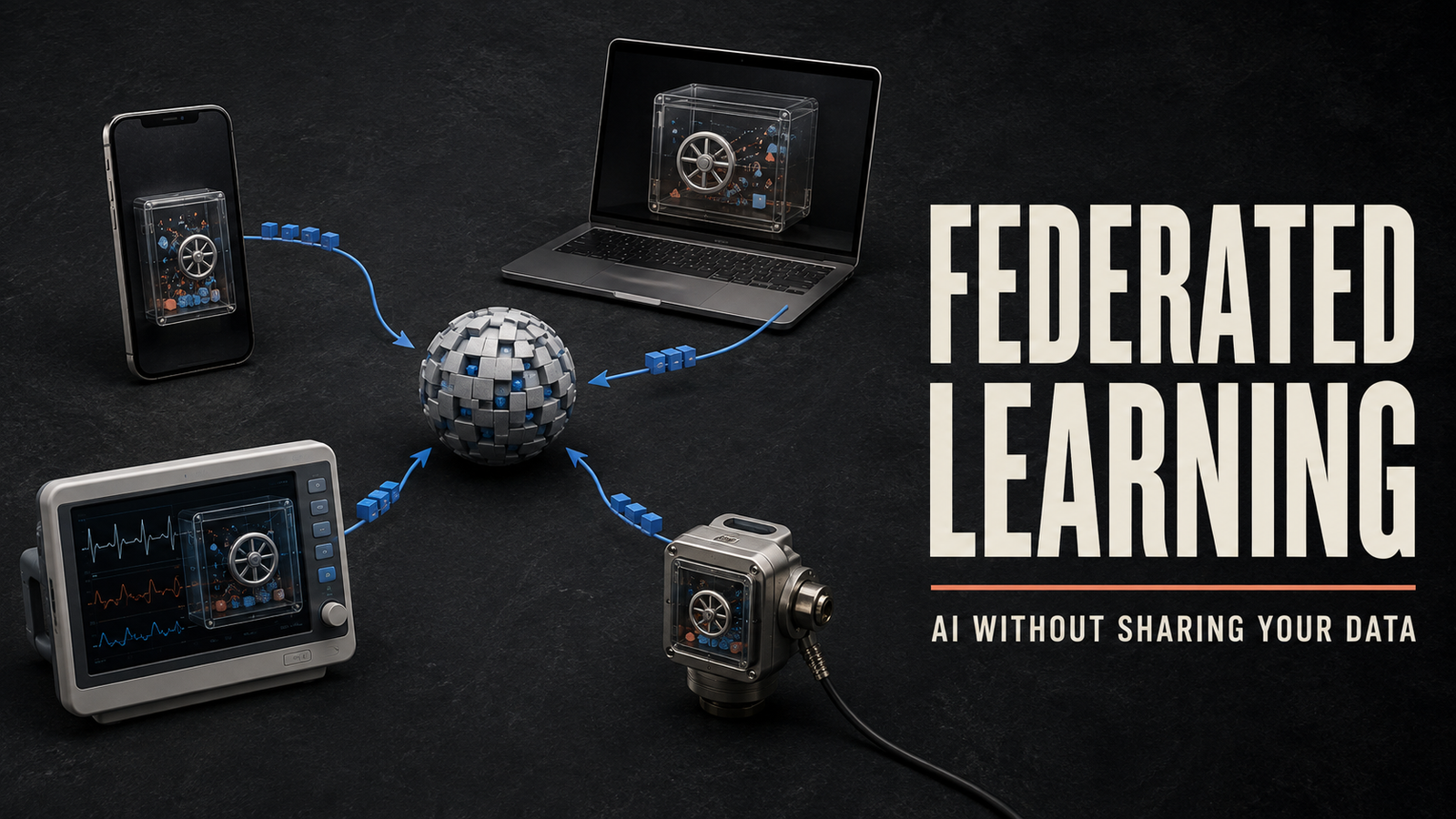
Instead of bringing all the data to the artificial intelligence model, federated learning sends the model to the locations where the data already exists. Each device or organisation improves the model locally and returns only an update—not its complete raw dataset.
These updates are combined to create a better shared model.
This makes it possible for artificial intelligence to learn from distributed information while allowing sensitive data to remain on individual devices or within participating organisations.
What Is Federated Learning?
Federated learning is a machine-learning approach in which multiple devices or organisations collaboratively train a shared model without sending all their raw data to a central server.
The word “federated” refers to separate participants working together while maintaining control over their own information.
These participants might include:
- Smartphones
- Laptops
- Wearable devices
- Hospitals
- Banks
- Vehicles
- Factories
- Retail stores
- Internet of Things devices
In traditional machine learning, information is usually gathered in one location. In federated learning, the data stays where it was originally created or stored.
A central system distributes an initial model to the participating devices. Each participant trains a local copy using its own data. It then sends a mathematical update back to the central system.
The central system combines these updates and produces an improved model, which can be distributed again.
The process may be repeated several times until the model reaches an acceptable level of performance.
How Does Federated Learning Work?
A federated learning system generally follows a series of training rounds.
1. A Shared Model Is Created
The process begins with an initial machine-learning model.
This model may already have basic capabilities, or it may begin with parameters that need to be improved through training.
A central server or coordinating platform manages the shared model.
2. The Model Is Distributed
The central system selects a group of participating devices or organisations and sends them the current version of the model.
Not every participant needs to be involved in every training round. A smartphone-based system, for example, may select only devices that are connected to power, using Wi-Fi and currently inactive.
3. Training Happens Locally
Each participating device trains its copy of the model using locally available information.
A smartphone keyboard might use typing patterns stored on the device. A hospital might train the model using records that remain within its protected systems.
The raw data does not need to be uploaded to the central server.
4. Model Updates Are Returned
After local training, each participant calculates how the model changed.
It sends the resulting model update—such as adjusted parameters or gradients—to the coordinating server.
These updates contain information that helps improve the shared model, but they are not supposed to contain the participant’s complete underlying dataset.
5. Updates Are Combined
The central server combines updates received from multiple participants.
A common approach is to average the updates while considering factors such as the amount of training data used by each participant.
The result becomes a new version of the shared model.
6. The Improved Model Is Redistributed
The updated model is sent back to participating devices.
Additional rounds of local training and aggregation continue until the model reaches the required performance level.
A Simple Example of Federated Learning
Consider a smartphone keyboard that predicts the next word while someone is typing.
People use language differently. Their word choices may depend on location, occupation, age, interests and personal writing style. Training a useful prediction model can therefore benefit from patterns across many users.
A traditional approach might upload typing data to a central database.
With federated learning, the keyboard model can improve locally using information stored on each phone. The phones return model updates instead of sending complete conversations or typing histories.
The central system combines updates from many devices and creates a better general model.
The improved model can then be distributed to users during a future software update.
This approach allows the model to learn from a wide range of behaviour while reducing the need to collect raw personal information in one place.
Federated Learning vs Traditional Machine Learning
The main difference between federated and traditional machine learning is where training data is processed.
| Feature | Federated Learning | Traditional Machine Learning |
|---|---|---|
| Data location | Remains across devices or organisations | Collected in a central location |
| Training process | Distributed across participants | Performed centrally |
| Information shared | Model updates | Raw or processed datasets |
| Privacy exposure | Can be reduced | Central collection may increase exposure |
| Network usage | Repeated model updates | Dataset uploads and central access |
| Device requirements | Participants may perform local computation | Central infrastructure performs most computation |
| Data control | Participants retain greater local control | Central operator controls the combined dataset |
Traditional machine learning may be simpler when data can be safely and legally collected in one place.
Federated learning becomes useful when information is sensitive, distributed, difficult to move or controlled by different organisations.
Why Is Federated Learning Important?
Modern devices and organisations generate enormous amounts of useful information. However, much of that data cannot—or should not—be freely transferred.
Medical information, financial transactions, private messages, business records and personal device activity may contain highly sensitive details.
Federated learning provides a way to use patterns within this information without always centralising it.
This does not make the system automatically private or secure. Model updates can still reveal information if they are not properly protected. Nevertheless, federated learning changes the basic data architecture and can reduce unnecessary movement of raw information.
Benefits of Federated Learning
Federated learning can offer advantages for both users and organisations.
Improved Data Privacy
The most widely discussed benefit is that raw information can remain on the device or within the organisation that owns it.
A hospital, for example, may contribute to a shared medical model without transferring its complete patient database to another institution.
Keeping data local can reduce direct exposure, although additional privacy techniques are still required.
Reduced Central Data Collection
Central databases containing large amounts of sensitive information can become valuable targets for attackers.
Federated learning can reduce the amount of raw data stored in one place. The central system manages model updates rather than maintaining a complete copy of every participant’s information.
The server itself must still be secured because models and updates may also be sensitive.
Access to Distributed Data
Some valuable datasets cannot easily be combined because of privacy requirements, commercial competition, legal restrictions or technical limitations.
Federated learning allows separate organisations to collaborate while retaining local control of their data.
More Personalised Experiences
A general model can be adapted locally to match an individual user or device.
For example, a shared keyboard model may learn general language patterns, while the version on a particular phone becomes better at predicting the words frequently used by its owner.
Lower Need for Data Transfers
Moving large datasets can consume bandwidth, time and storage.
Federated learning avoids repeatedly transferring raw information. However, model updates can still be large, and multiple communication rounds may be required.
Learning From Recent Local Behaviour
Devices can train using information generated during real-world use.
This can help models adapt to changing behaviour or local conditions without waiting for a complete central dataset to be rebuilt.
Real-World Applications of Federated Learning
Federated learning can be useful in any environment where data is distributed and privacy or ownership matters.
Smartphones and Personal Devices
Mobile devices generate information about typing, voice commands, application usage and other behaviour.
Federated learning can help improve features such as:
- Predictive keyboards
- Voice recognition
- Search suggestions
- Personalised recommendations
- Device performance
- Battery management
Local training can reduce the need to upload complete activity records.
Healthcare
Medical organisations hold valuable but highly sensitive data.
Hospitals may have different patient populations, equipment and areas of expertise. Training a model across several institutions could improve its ability to recognise medical patterns.
Federated learning allows participating hospitals to train a shared model while keeping patient records within their own systems.
Healthcare applications require careful validation, strong security and compliance with relevant privacy requirements. A model should not be considered safe or accurate simply because it was trained using federated learning.
Financial Services
Banks and payment providers use machine learning to identify suspicious behaviour, assess risk and detect fraud.
Different institutions may observe different parts of fraudulent activity but cannot freely exchange customer records.
Federated learning could allow them to improve shared detection models without pooling complete transaction histories.
Connected Vehicles
Modern vehicles generate information about road conditions, driver assistance, component performance and traffic.
A vehicle can train or improve a model locally before sending an update to a central system. The combined model may then help other vehicles recognise similar conditions.
Because vehicles can have inconsistent connectivity, the system must handle participants joining and leaving training rounds.
Manufacturing
Factories often collect operational data from machinery, sensors and production lines.
Businesses may want to improve maintenance or quality-control models across several locations without transferring confidential production data.
Federated learning can support collaboration between factories while allowing each facility to maintain control of its records.
Retail
Retail stores can generate local information about demand, stock levels, purchases and customer behaviour.
A retail group could improve forecasting models across multiple stores without moving every transaction into a single training dataset.
Cybersecurity
Cybersecurity systems need to recognise emerging attacks across devices and networks.
Federated learning can allow separate systems to contribute to a shared threat-detection model while reducing the need to exchange detailed security logs.
Different Types of Federated Learning
Federated learning can be organised in several ways.
Cross-Device Federated Learning
Cross-device federated learning involves a large number of personal or connected devices.
Participants may include smartphones, smartwatches and home devices. Individual devices may have limited computing power and may be available only occasionally.
The system must work even when many participants disconnect or fail to return an update.
Cross-Silo Federated Learning
Cross-silo federated learning involves a smaller number of organisations with more reliable infrastructure.
Examples may include hospitals, banks, universities or regional offices of the same company.
Each participant usually has a significant dataset and greater computing capacity than an individual consumer device.
Horizontal Federated Learning
Horizontal federated learning is used when participants have similar types of data but information about different users or entities.
For example, several hospitals may store comparable medical fields for different patients.
Vertical Federated Learning
Vertical federated learning is used when participants hold different types of information about some of the same individuals or entities.
For example, a bank and an online retailer may possess different information relating to overlapping customers.
This form of collaboration requires careful identity matching and privacy protection.
Is Federated Learning Completely Private?
No. Federated learning improves data locality, but it does not guarantee complete privacy.
A poorly designed model update may reveal information about the data used to create it. Attackers may attempt to reconstruct sensitive details or determine whether a particular record participated in training.
Several techniques can provide additional protection.
Secure Aggregation
Secure aggregation allows the server to calculate a combined result without reading each participant’s individual update.
The server receives useful information about the group while gaining less visibility into any single contribution.
Differential Privacy
Differential privacy introduces carefully controlled randomness into data or model updates.
Its purpose is to make it more difficult to identify the influence of a particular person while preserving useful overall patterns.
Encryption
Information can be encrypted during transmission and storage. More advanced systems may also use cryptographic methods designed to perform certain calculations on protected data.
Participant Selection and Access Controls
The system should verify which devices or organisations are authorised to join training. It should also monitor suspicious behaviour and prevent unauthorised access to models or updates.
Federated learning should be understood as one part of a broader privacy and security strategy.
Challenges of Federated Learning
Despite its advantages, federated learning introduces significant technical challenges.
Uneven Data
Participants may generate very different types and amounts of information.
One phone owner may type in several languages, while another uses only short messages. One hospital may specialise in a condition rarely seen by another institution.
These differences can make it difficult to build a model that performs well for everyone.
Limited Device Resources
Personal devices have limited processing power, battery life and storage.
Local training must avoid slowing down the device or consuming excessive energy.
Unreliable Connectivity
Devices may disconnect, switch networks or become unavailable during training.
Federated systems must tolerate incomplete rounds and delayed updates.
Communication Costs
Raw data remains local, but model updates still need to travel across networks.
Large models or frequent training rounds can create substantial communication requirements.
Malicious Participants
A compromised participant could submit manipulated updates designed to damage the shared model or create hidden behaviour.
Federated systems need methods to detect suspicious contributions without unfairly rejecting legitimate differences.
Difficult Monitoring
When raw data remains distributed, developers cannot inspect all training examples in one location.
This makes debugging, testing and identifying biased data more complicated.
Regulatory and Governance Questions
Organisations need clear agreements about who manages the shared model, who can use it and who is responsible when it produces harmful or inaccurate results.
Federated Learning vs Edge Computing
Federated learning and edge computing both involve processing information outside a central cloud platform, but they serve different purposes.
Edge computing processes data near the location where it is generated. Its goal may be to reduce latency, bandwidth usage or dependence on internet connectivity.
Federated learning is specifically a method for training machine-learning models across distributed participants.
A system can use both technologies. An edge device may process data locally and participate in federated learning by sending model updates to a coordinating server.
Can Federated Learning Improve AI Fairness?
Federated learning can expose a model to data from different locations and user groups, which may improve representation.
However, it does not automatically make a model fair.
Devices with reliable internet connections, newer hardware or more frequent activity may participate more often. Some groups may still be underrepresented. The system’s method for combining updates can also affect whose patterns influence the final model.
Developers must evaluate performance across relevant groups rather than assuming that distributed training removes bias.
Frequently Asked Questions About Federated Learning
What is federated learning in simple terms?
Federated learning is a way to train one shared AI model across multiple devices or organisations without collecting all their raw data in one place.
Who sends what in federated learning?
A central system sends a model to participants. Participants train it using local data and return model updates rather than complete raw datasets.
Is federated learning the same as distributed learning?
Federated learning is a form of distributed machine learning, but it places particular emphasis on decentralised data, participant control and privacy-related challenges.
Does federated learning require the internet?
Participants normally need network connectivity to receive models and send updates. Local training may occur without a continuous connection.
Can federated learning be hacked?
Like any technology, federated learning can be attacked. Threats include malicious model updates, attempts to extract information and compromised participants. Strong security and privacy controls remain necessary.
Is federated learning only used on smartphones?
No. It can also be used by hospitals, banks, factories, vehicles, retailers and other organisations that hold distributed data.
What is the biggest limitation of federated learning?
One of its biggest challenges is coordinating reliable training across participants with different data, hardware, availability and network conditions.
Final Thoughts
Federated learning changes the traditional relationship between artificial intelligence and data.
Instead of transferring every piece of information to a central database, it allows models to learn across devices and organisations while raw data remains closer to its source.
This approach can reduce central data collection, support collaboration and create more personalised technology. It is particularly valuable in fields such as healthcare, finance and mobile computing, where information is both useful and sensitive.
Federated learning is not a complete privacy solution. Model updates may still expose information, participants may behave maliciously and distributed training can be difficult to manage.
Its greatest value comes when it is combined with encryption, secure aggregation, differential privacy, access controls and responsible model evaluation.
As artificial intelligence becomes more integrated into everyday devices and critical systems, federated learning offers a promising path toward models that can improve collectively without requiring everyone to surrender complete control of their data.