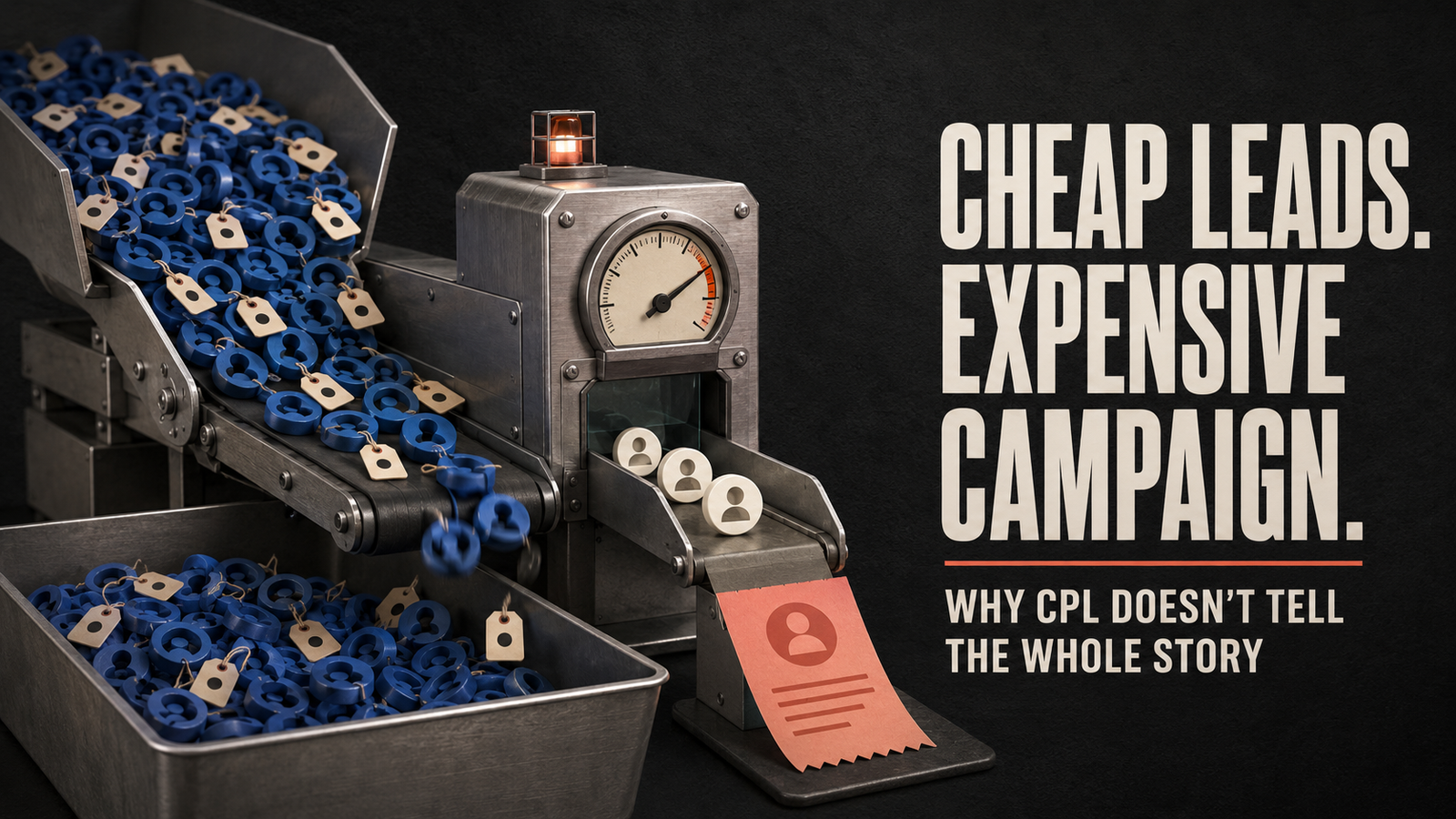

A campaign generates 500 leads at ₹100 each.
Another campaign produces only 100 leads at ₹500 each.
At first glance, the first campaign appears significantly better. It delivers five times more leads at one-fifth of the cost.
The advertising dashboard will probably highlight the cheaper campaign. The marketing report may celebrate the low cost per lead, and the business may move more budget toward it.
But what if only five of those 500 leads are qualified?
What if the second campaign produces 40 qualified opportunities and 10 paying customers?
The cheaper campaign may actually be the more expensive one.
Cost per lead is easy to measure, which is why it receives so much attention. But businesses do not generate revenue from lead-form submissions. They generate revenue from customers.
A good lead-generation strategy must therefore evaluate what happens after the lead enters the system.
What Is Cost per Lead?
Cost per lead, commonly abbreviated as CPL, measures how much a business spends to generate one lead.
The formula is:
Cost per Lead = Total Campaign Spend ÷ Number of Leads
If a campaign spends ₹50,000 and generates 250 leads:
₹50,000 ÷ 250 = ₹200 CPL
This number helps marketers compare campaign efficiency.
The problem is that CPL treats every lead as equally valuable.
A person who is genuinely interested, has the required budget and is ready to speak with the business counts as one lead.
A student researching a project, a person outside the service area or someone who entered a false phone number also counts as one lead.
The metric does not distinguish between them.
What Is Lead Quality?
Lead quality describes how likely a lead is to become a valuable customer.
A high-quality lead normally matches important business criteria, such as:
- Genuine interest
- Need for the product or service
- Suitable budget
- Correct location
- Relevant industry or profile
- Decision-making authority
- Realistic purchase timeline
- Valid contact information
- Willingness to communicate
The exact definition depends on the business.
A qualified lead for a dental clinic is different from a qualified lead for a software company. A real-estate developer may value budget and location, while a business-to-business service may prioritise company size and decision-making authority.
Lead quality must be defined with the sales team rather than assumed by the advertising platform.
Cheap Leads Can Create Expensive Sales
Consider two hypothetical campaigns.
| Metric | Campaign A | Campaign B |
|---|---|---|
| Advertising spend | ₹50,000 | ₹50,000 |
| Total leads | 500 | 100 |
| Cost per lead | ₹100 | ₹500 |
| Qualified leads | 10 | 40 |
| Cost per qualified lead | ₹5,000 | ₹1,250 |
| Customers acquired | 1 | 10 |
| Customer acquisition cost | ₹50,000 | ₹5,000 |
Campaign A wins on CPL.
Campaign B wins on almost every business metric that matters.
If the company evaluates only the advertising dashboard, it may pause Campaign B and increase the budget for Campaign A.
This would improve the visible CPL while making the business less profitable.
The Lead-Generation Funnel
A lead is only one stage of the customer journey.
A typical lead-generation funnel may include:
- Advertisement impression
- Click
- Landing page visit
- Lead submission
- Contactable lead
- Marketing-qualified lead
- Sales-qualified lead
- Appointment or meeting
- Proposal
- Customer
- Revenue
A campaign can perform well at the top and fail later.
For example:
- A high click-through rate may indicate strong creative.
- A high form-submission rate may indicate an easy form.
- A high contact rate may indicate valid data.
- A high qualification rate may indicate relevant targeting.
- A high closing rate may indicate strong sales follow-up.
- A high customer value may indicate profitable acquisition.
Marketers need to understand where the funnel is breaking instead of using one metric to judge the entire system.
Metrics That Matter Beyond CPL
Cost per lead is still useful. It simply needs to be viewed alongside deeper metrics.
Contact Rate
Contact rate shows what percentage of leads can be successfully reached.
Contact Rate = Contacted Leads ÷ Total Leads × 100
A low contact rate may indicate fake numbers, low intent, slow follow-up or weak form verification.
Qualification Rate
Qualification rate shows what percentage of leads meet the business’s defined criteria.
Qualification Rate = Qualified Leads ÷ Total Leads × 100
If one campaign has a higher CPL but a much stronger qualification rate, it may be the better investment.
Cost per Qualified Lead
Cost per qualified lead measures the cost of generating someone who genuinely matches the business requirements.
Cost per Qualified Lead = Campaign Spend ÷ Qualified Leads
This is often more useful than basic CPL.
Appointment Rate
For clinics, consultants, real estate and other service businesses, appointment rate is an important middle-funnel metric.
Appointment Rate = Appointments Booked ÷ Total Leads × 100
Businesses may also measure appointments as a percentage of qualified leads.
Show-Up Rate
A booked appointment has little value if the prospect never attends.
Show-Up Rate = Completed Appointments ÷ Booked Appointments × 100
Reminders, confirmation calls and rescheduling options can influence this rate.
Lead-to-Sale Rate
Lead-to-sale rate shows how many leads become customers.
Lead-to-Sale Rate = Customers Acquired ÷ Total Leads × 100
This connects marketing activity with business results.
Customer Acquisition Cost
Customer acquisition cost measures how much the business spends to gain one customer.
A complete calculation may include advertising, marketing tools, agency fees, sales salaries and other acquisition-related costs.
At campaign level, a simplified figure is:
Customer Acquisition Cost = Campaign Spend ÷ Customers Acquired
Revenue per Lead
Revenue per lead shows the average revenue generated across all leads.
Revenue per Lead = Revenue From Leads ÷ Total Leads
This metric helps reveal whether a higher CPL is justified by stronger outcomes.
Return on Advertising Spend
Return on advertising spend compares revenue attributed to a campaign with advertising expenditure.
ROAS = Attributed Revenue ÷ Advertising Spend
Revenue attribution must be reliable. A platform-reported lead is not the same as confirmed revenue.
Why Advertising Platforms Optimise for Cheap Leads
Advertising platforms optimise toward the conversion event they receive.
If the campaign tells the system that every submitted form is a successful conversion, the platform will look for people likely to submit forms.
It does not automatically know:
- Whether the phone number is valid
- Whether the lead answers calls
- Whether the prospect has the required budget
- Whether the lead is located in the service area
- Whether the prospect becomes a customer
- Whether the sale is profitable
If low-quality leads are still sent back as successful conversions, the algorithm receives the wrong signal.
Over time, it may become increasingly efficient at generating more of the same poor-quality activity.
The solution is not to blame automation. The solution is to feed it better information.
Common Causes of Low-Quality Leads
Poor lead quality can come from several parts of the campaign.
Misleading Advertising Copy
An advertisement may promise something much easier or cheaper than the actual offer.
People click based on that expectation and lose interest when they learn the complete terms.
The creative should attract the right prospect, not the largest possible audience.
Weak Audience Targeting
Broad targeting can be effective when the platform receives strong conversion feedback.
It becomes risky when the conversion event is a simple, low-friction form submission with no quality signals.
Too Little Information in the Advertisement
An advertisement that hides the price range, location, eligibility or service details may generate curiosity clicks from unsuitable users.
Adding qualifying information can reduce lead volume while improving relevance.
Overly Easy Forms
A short instant form can increase submissions, but it may also attract accidental and low-intent responses.
Review steps, intent questions and higher-friction forms can improve quality.
The goal is not to make forms difficult. It is to require enough deliberate action to identify genuine interest.
Irrelevant Placements
Some placements may generate accidental clicks or users who are unlikely to complete a serious purchase.
Performance should be reviewed by placement, device and audience context.
Incentives That Attract the Wrong Person
A giveaway, free consultation or downloadable resource may attract people interested only in the incentive.
The offer should be closely related to the paid product or service.
Poor Landing Page Communication
If the landing page does not clearly explain the service, visitors may submit a form without understanding what happens next.
Clear information can filter unsuitable prospects before they become leads.
Geographic Mismatch
Leads may come from locations the business cannot serve.
Location settings, radius targeting and form questions should be checked carefully.
Lead Quality Is Not Only a Marketing Problem
Marketing can generate a relevant enquiry and still receive feedback that the lead was poor.
The issue may actually be:
- Slow follow-up
- Repeated unanswered calls with no message
- Weak sales scripts
- Poor lead distribution
- No follow-up sequence
- Inconsistent CRM updates
- Calling at unsuitable times
- Lack of product knowledge
- Inability to handle objections
- Failure to explain the offer
If a high-intent lead waits two days for a response, their interest may disappear or they may contact a competitor.
The business should separate three questions:
- Was the lead relevant?
- Was the lead contacted effectively?
- Was the sales conversation handled well?
Without this separation, marketing and sales teams may blame each other without identifying the real problem.
How to Define a Qualified Lead
A qualification framework should be specific enough for consistent reporting.
For example, a qualified solar-installation lead might require:
- A valid name and phone number
- Ownership or decision-making authority
- A property within the service area
- Genuine interest in installing solar
- An appropriate type of property
- A realistic purchase timeline
- Willingness to speak with the team
A qualified clinic lead might require:
- Interest in a treatment the clinic offers
- Suitable location
- Valid contact information
- Basic eligibility
- Ability to attend an appointment
- Genuine intent to explore treatment
The criteria should be documented and applied consistently.
If one salesperson marks every unresponsive lead as “unqualified” while another keeps it as “not contacted,” campaign analysis becomes unreliable.
Use Lead-Quality Stages in the CRM
A simple lead-status structure can improve reporting.
Useful stages may include:
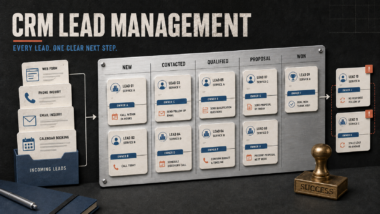
- New
- Attempted Contact
- Contacted
- Invalid
- Duplicate
- Not Relevant
- Qualified
- Appointment Booked
- Appointment Completed
- Proposal Sent
- Won
- Lost
Every status should have a clear meaning.
The CRM should also record the original:
- Source
- Medium
- Campaign
- Advertisement
- Keyword
- Landing page
This makes it possible to compare quality and revenue across campaigns.
Send Offline Outcomes Back to Advertising Platforms
Where appropriate integrations are available, businesses can send qualified-lead and sale outcomes back to their advertising platforms.
Instead of optimising only for form submissions, the campaign may learn from deeper events such as:
- Qualified lead
- Appointment booked
- Purchase completed
- Revenue generated
This gives the platform a better signal.
The business must maintain valid consent, privacy practices and secure data handling when sharing customer information.
How to Improve Lead Quality Without Destroying Volume
Lead quality and volume do not have to be complete opposites.
Add Qualifying Information to the Advertisement
Include details that help unsuitable users decide not to click.
This may include:
- Location
- Starting price
- Target customer
- Service type
- Eligibility
- Minimum commitment
- Relevant timeline
A lower click-through rate can be acceptable if the remaining clicks are more valuable.
Ask One or Two Meaningful Questions
Good qualification questions reveal intent without creating unnecessary friction.
Examples include:
- When are you planning to start?
- Which service are you interested in?
- What type of property do you own?
- What is your approximate budget range?
- Where is your business located?
Avoid questions that the sales team never uses.
Improve the Offer
Low-quality leads may indicate that the offer attracts curiosity rather than purchase intent.
A free guide may generate downloads. A strategy consultation may generate fewer but stronger enquiries.
Choose the offer based on the desired stage of the funnel.
Improve Message Match
The advertisement, landing page and sales conversation should describe the same offer.
If the advertisement promises one thing and the salesperson explains another, the lead will appear weak even when the targeting was correct.
Use a Confirmation Step
After form submission, ask the lead to:
- Choose an appointment time
- Confirm a phone number
- Reply to a message
- Complete a short eligibility step
- Review the expected next action
Additional commitment can reveal stronger intent.
Follow Up Quickly
Lead interest is usually strongest near the time of enquiry.
Automated confirmations and efficient lead assignment can help the sales team respond sooner.
Nurture Leads Who Are Not Ready
Not every relevant lead is ready to purchase immediately.
Email, messaging and remarketing can keep the business visible while the prospect continues evaluating options.
Marking every long-term prospect as poor quality may underestimate the campaign.
When a Higher CPL Is Acceptable
A higher CPL can be healthy when it produces:
- More qualified leads
- Better contact rates
- Higher appointment rates
- Stronger show-up rates
- Higher closing rates
- Greater average order value
- More profitable customers
- Higher lifetime value
- Lower sales workload
The question should not be, “Can we reduce CPL?”
The better question is, “Can we reduce the cost of acquiring a profitable customer?”
Sometimes reducing CPL helps. Sometimes it damages the campaign by attracting lower-intent users.
A Better Campaign Reporting Format
Instead of presenting only spend, leads and CPL, use a deeper report.
| Metric | Purpose |
| Advertising Spend | Shows campaign investment |
| Total Leads | Measures response volume |
| Cost per Lead | Measures top-level efficiency |
| Contactable Leads | Identifies valid opportunities |
| Qualified Leads | Measures relevance |
| Cost per Qualified Lead | Connects spend with quality |
| Appointments | Measures sales progress |
| Customers | Shows actual acquisition |
| Customer Acquisition Cost | Measures business efficiency |
| Revenue | Shows financial result |
| ROAS | Compares revenue with ad spend |
This report may show fewer impressive vanity numbers, but it creates better decisions.
Frequently Asked Questions About CPL and Lead Quality
What is a good cost per lead?
There is no universal good CPL. It depends on lead quality, conversion rate, customer value, profit margin, industry and sales process.
Are cheap leads always low quality?
No. A campaign can produce both affordable and qualified leads. The point is that CPL alone cannot confirm quality.
How do I calculate cost per qualified lead?
Divide total campaign spend by the number of leads that meet the business’s qualification criteria.
Why are my leads not answering calls?
Possible reasons include slow follow-up, accidental submissions, weak intent, incorrect numbers, unsuitable call timing or leads not recognising the caller.
Should I add more questions to my lead form?
Add only questions that help qualify or route the lead. Too many unnecessary questions may reduce genuine submissions.
Can broad targeting generate qualified leads?
Yes, particularly when the platform receives strong conversion signals and the advertisement clearly communicates the offer. Results depend on the market and campaign setup.
Should marketing be responsible for sales?
Marketing should be accountable for lead relevance and acquisition performance. Sales is responsible for contact, qualification and conversion. Both teams need shared definitions and reporting.
What metric should replace CPL?
CPL should not necessarily be removed. It should be combined with cost per qualified lead, customer acquisition cost, lead-to-sale rate, revenue and profitability.
Final Thoughts
Cheap leads can make a campaign look efficient while quietly consuming the sales team’s time and the business’s advertising budget.
A low CPL is valuable only when those leads move through the funnel.
The complete question is not:
“How many leads did we generate?”
It is:
“How many relevant prospects did we reach, how many became customers, and what did each customer cost us?”
Marketing teams should track more than form submissions. Sales teams should provide structured feedback. Advertising platforms should receive stronger conversion signals, and campaign reports should connect spend with qualified opportunities and revenue.
The goal is not to generate the cheapest lead.
The goal is to acquire profitable customers at a sustainable cost.