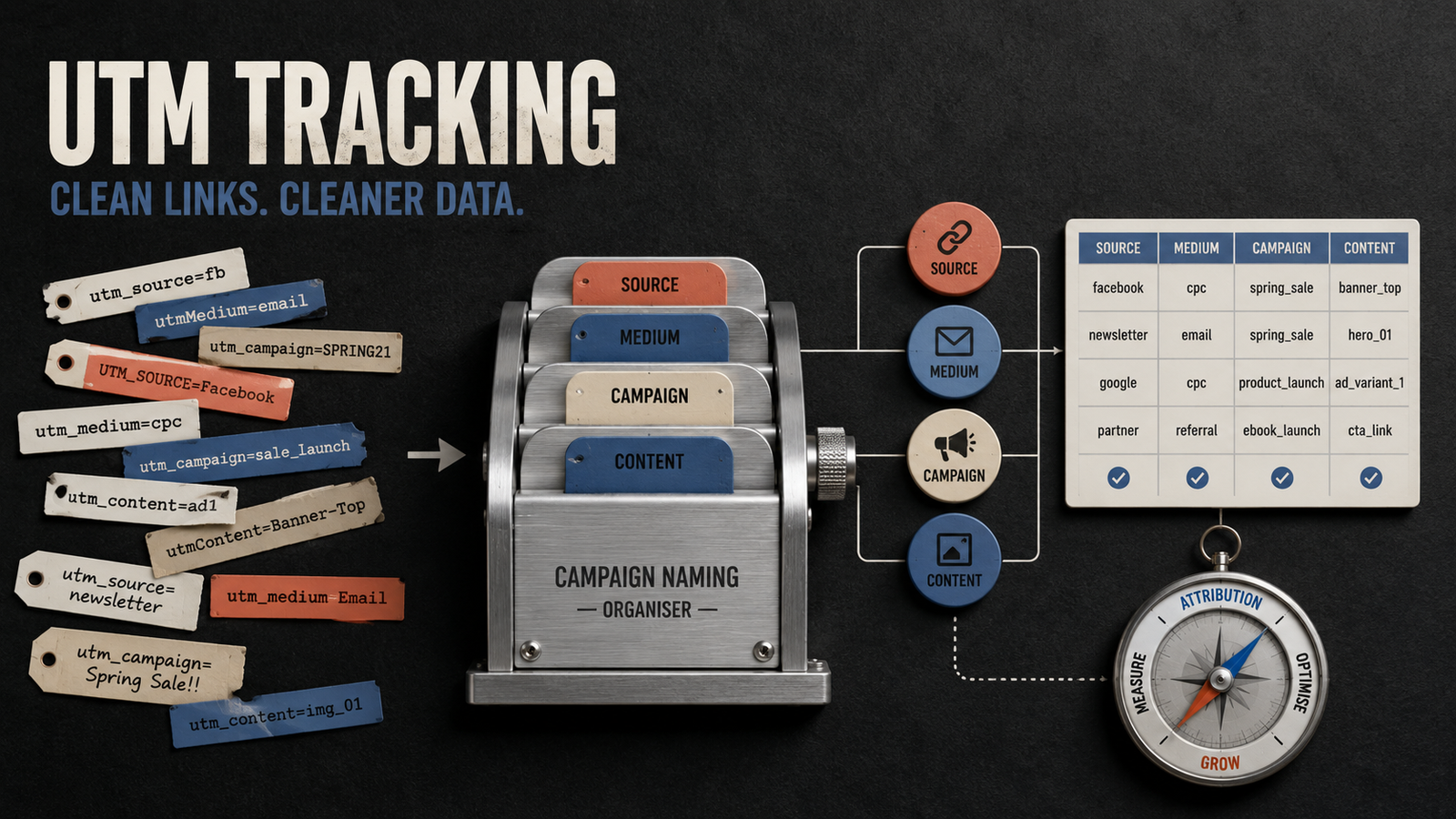

Campaign tracking often appears reliable until someone examines the data closely.
One campaign may be recorded as “Facebook,” another as “facebook,” and a third as “fb.” Paid social traffic might appear under “paid-social,” “cpc,” “social,” or even “referral.” The campaigns may all generate clicks and leads, but inconsistent naming fragments the data across multiple rows.
As a result, marketers cannot easily answer basic questions:
- Which campaign produced the lead?
- Which advertisement introduced the customer?
- How much revenue came from paid social?
- Did the email campaign contribute to the conversion?
- Are two analytics rows different campaigns or simply different spellings?
UTM tracking helps solve this problem. However, adding random UTM parameters to every link is not enough. The real value comes from using a consistent campaign naming system that the entire marketing team understands.
In this guide, I will explain how UTM parameters work, how I recommend structuring them, and how clean campaign naming strengthens the broader marketing attribution process.
1. What Is UTM Tracking?
UTM tracking is a method of adding descriptive parameters to the end of a destination URL. These parameters tell analytics tools where a visitor came from and which marketing activity brought that person to the website.
Consider this ordinary landing-page URL:
A tracked version might look like this:
Both links open the same page. The difference is that the tracked URL carries useful campaign information.
When someone clicks it, an analytics platform can read the parameters and associate the visit with a specific source, channel, campaign, and advertisement.
UTM parameters do not create conversions, track phone calls automatically, or decide which channel deserves credit. They label inbound traffic. Conversion events, analytics configuration, CRM data, and an attribution model are still required to evaluate performance properly.
2. What Are the Five Main UTM Parameters?
A standard UTM-tagged URL can contain five parameters. Each parameter has a specific purpose within the campaign tracking system.
utm_source
The source identifies the website, publisher, platform, or partner sending the traffic.
Common examples include:
googlelinkedinnewsletterpartner-nameindustry-publication
The source should answer the question: Where did this visitor come from?
Avoid using a broad channel description such as paid-social as the source. That information belongs in the medium field.
utm_medium
The medium describes the marketing channel or traffic type.
Examples include:
cpcpaid-socialemailaffiliatereferraldisplay
The medium should answer: How was the visitor acquired?
A useful distinction is that google might be the source, while cpc is the medium. Similarly, a newsletter provider or publication could be the source, while email is the medium.
utm_campaign
The campaign parameter identifies the promotion, initiative, or strategic campaign.
Examples include:
marketing-audit-indiasummer-product-launchq3-solar-leadsretargeting-free-consultation
This parameter should be descriptive enough that a marketer can understand it several months later without opening the advertising account.
utm_term
The term parameter was traditionally used to record a paid-search keyword. It can also be used for an audience or targeting label when that information is not captured automatically.
Examples include:
digital-marketing-agencybusiness-ownerswebsite-visitors-30d
This field is optional. Do not add it merely because it exists. Every parameter should have a clear reporting purpose.
utm_content
The content parameter distinguishes advertisements, creative variations, calls to action, or links within the same campaign.
Examples include:
video-testimonialstatic-benefit-01header-ctablue-buttonresponsive-ad-02
This parameter is especially helpful when several advertisements use the same source, medium, and campaign.
3. Why Does Consistent UTM Naming Matter?
A UTM parameter is only useful when its value is predictable.
Suppose three people create links for the same paid-social channel:
utm_medium=paid-socialutm_medium=PaidSocialutm_medium=social-paid
An analytics tool may treat those as three separate mediums. Instead of seeing one complete paid-social total, the marketer receives fragmented rows.
The problem becomes more serious when campaign data is passed into a CRM. Leads from the same channel may be placed in different reports, automation rules may fail, and revenue attribution can become unreliable.
Clean UTM data supports the entire full-funnel lead-generation system. It connects the click at the beginning of the journey with the lead, sales conversation, and eventual business result.
Without consistent tracking, a team might optimize campaigns that appear successful instead of the campaigns that actually create qualified opportunities.
4. How Should You Name UTM Parameters?
A good naming convention should be simple enough to use every day and structured enough to support useful reporting.
Use lowercase letters
Choose google, not Google or GOOGLE.
Analytics systems may treat uppercase and lowercase values differently. Lowercase naming removes that unnecessary variation.
Avoid spaces
Spaces can be encoded inside a URL and make links harder to read. Use a hyphen instead.
For example:
marketing-audit-india
is cleaner than:
Marketing Audit India
Choose one separator
Both hyphens and underscores can work, but mixing them creates inconsistency.
I generally prefer hyphens because campaign values remain readable:
lead-generation-guide
Whichever format you choose, document it and use it everywhere.
Keep source and medium separate
The source identifies where the traffic originated. The medium identifies the channel.
A sensible combination would be:
utm_source=linkedin&utm_medium=paid-social
Using linkedin-paid-social as the source combines two different dimensions and reduces reporting flexibility.
Use stable channel definitions
Decide which medium values your business will recognize. A basic list might include:
cpcpaid-socialemaildisplayreferralaffiliate
Do not alternate between cpc, ppc, and paid-search unless there is a deliberate reporting reason.
Never include personal information
UTM values can appear in browsers, analytics records, server logs, and shared links. Never place names, email addresses, phone numbers, or other personally identifiable information inside them.
Use anonymous campaign and creative identifiers instead.
5. What Does a Practical UTM Taxonomy Look Like?
The following framework can serve as a starting point:
| Parameter | Purpose | Recommended examples |
|---|---|---|
utm_source | Identifies the traffic origin | google, linkedin, newsletter, partner-name |
utm_medium | Identifies the marketing channel | cpc, paid-social, email, referral |
utm_campaign | Identifies the strategic initiative | q3-solar-leads, marketing-audit-india |
utm_term | Identifies a keyword or audience | digital-marketing-agency, business-owners |
utm_content | Identifies a creative or link variation | video-01, header-cta, benefit-ad-02 |
This taxonomy should be adapted to the way the business actually reports performance. A complicated structure is not automatically better. Every field should help someone understand performance or make a decision.
6. UTM Tracking Examples for Different Channels
The structure may change slightly depending on the channel being tracked.
Paid-search campaign
This URL identifies the search platform, paid-click medium, campaign, keyword, and advertisement variation.
Paid-social campaign
The content value separates this document advertisement from other creative formats within the campaign.
Email newsletter
This link makes it possible to separate newsletter traffic from paid promotion while keeping both activities within the broader lead-generation campaign.
If all three channels promote the same optimized landing page, their UTM parameters help identify which traffic sources contributed to the page’s results.
7. How Do You Build a Campaign Tracking Sheet?
A shared campaign tracking sheet is one of the easiest ways to prevent naming errors.
Useful columns include:
- Date created
- Campaign owner
- Destination URL
- Source
- Medium
- Campaign
- Term
- Content
- Final tracked URL
- Launch date
- Campaign status
- Notes
Use controlled dropdowns for fields such as source and medium whenever possible. This prevents team members from creating unnecessary spelling variations.
The sheet also becomes a campaign history. When a marketer encounters an unfamiliar value in an analytics report, the original link and its purpose can be checked without searching through multiple advertising accounts.
A tracking sheet is particularly useful when several people work on paid media, email marketing, partnerships, content promotion, and reporting.
8. How Should You Test UTM Links Before Launch?
Even a well-designed naming convention can fail if the final URL is incorrect.
Before publishing a campaign, check the following:
- Does the link open the correct landing page?
- Are all parameter names spelled correctly?
- Are source and medium values taken from the approved list?
- Is the campaign value consistent across related advertisements?
- Does the content value identify the correct creative?
- Are there accidental spaces or capital letters?
- Does the page work on desktop and mobile?
- Is the visit recorded correctly in the analytics platform?
- Are the UTM values captured when a form is submitted?
- Does the CRM store those values with the lead?
This final point is particularly important for lead-generation businesses.
If UTM data exists only in web analytics, the marketing team may know which campaign generated a form submission but not which campaign generated a qualified sales conversation.
Preserving source information in the CRM helps connect marketing acquisition with the lead follow-up process.
9. What Are the Most Common UTM Tracking Mistakes?
Using inconsistent capitalization
Newsletter, newsletter, and NEWSLETTER can become separate report entries.
Naming every medium cpc
CPC describes a paid-click category, but it may not always provide enough channel detail. Establish medium values that reflect how the business wants to compare channels.
Placing the channel in the wrong field
Using paid-social as a source makes it harder to compare individual platforms within that channel.
Adding UTMs to internal website links
UTM parameters should normally describe external inbound traffic. Adding them to internal navigation can overwrite or distort the visitor’s original acquisition information.
Use event tracking or another internal measurement method for buttons and navigation elements.
Changing names during a live campaign
If half of a campaign uses one value and the other half uses a new value, the report becomes fragmented. When a correction is unavoidable, record the change in the campaign tracking sheet.
Copying the wrong destination URL
A perfectly formatted UTM structure is useless if the advertisement sends visitors to an outdated or irrelevant page.
Tracking clicks without tracking outcomes
A UTM code can show where traffic originated, but it does not reveal whether a lead was qualified or whether the customer purchased.
Campaign data should be combined with conversion events and downstream CRM outcomes.
10. How Are UTMs Different From Pixels and Conversion Events?
These tools perform different jobs within a marketing measurement system.
- UTM parameters describe the origin and context of a visit.
- Analytics tags or pixels record actions taken on the website.
- Conversion events identify important actions such as form submissions or purchases.
- CRM fields preserve campaign information after someone becomes a lead.
- Attribution models determine how conversion credit is distributed.
No single tool provides a complete view of performance.
For example, a UTM parameter may identify a visitor as coming from an email campaign. An analytics event records the form submission, the CRM stores the lead, and the sales team later records whether the opportunity was successful.
That is why campaign naming should be treated as part of a larger measurement system rather than a last-minute addition to an advertisement.
11. How Does Clean UTM Tracking Improve Marketing Decisions?
Reliable UTM data allows marketers to:
- Compare channels using consistent categories
- Identify high-performing campaigns and creative variations
- Connect landing-page behavior with traffic sources
- Investigate differences between lead volume and lead quality
- Preserve acquisition data throughout the sales process
- Create clearer reports for clients or internal stakeholders
- Find tracking gaps before increasing the campaign budget
It also reduces unproductive debates.
When definitions are agreed upon before a campaign launches, the team spends less time cleaning reports and more time interpreting results.
Clean tracking does not automatically improve campaign performance. It improves the quality of the information used to make optimization decisions.
12. A Simple UTM Tracking Process to Follow
A reliable UTM process does not need to be complicated. It can be organized into seven steps:
- Define the approved source and medium values.
- Establish a campaign naming structure.
- Record every campaign in a central tracking sheet.
- Generate the final tracked URL.
- Test the destination and all parameters.
- Confirm that the data appears correctly in analytics.
- Preserve the original UTM values inside the CRM.
The same process should be followed for every relevant campaign, regardless of who creates it.
Consistency is more valuable than unnecessary complexity. A simple system followed by everyone will produce better data than an advanced system followed by only one person.
Final Thoughts
Effective UTM tracking is not about creating the longest possible campaign URL. It is about creating a shared marketing language.
When source, medium, campaign, and content values follow a consistent structure, campaign data becomes easier to understand and trust. That clean acquisition data can support landing-page analysis, lead-quality evaluation, sales follow-up, and revenue attribution.
Start with a small approved taxonomy, maintain a central campaign tracking sheet, and test every link before launch. These habits may appear operational, but they directly affect the quality of strategic marketing decisions.
A marketer can only optimize what has been measured clearly—and clear measurement begins with consistent naming.