
A campaign can generate hundreds of clicks and still produce no meaningful business results.
It can also appear to generate dozens of conversions while the sales team receives duplicate forms, irrelevant inquiries, accidental calls, or leads that cannot be contacted.
This is why clicks, impressions, and website visits are not enough to evaluate digital marketing performance. Marketers need conversion tracking to understand what happens after someone reaches the website.
However, conversion tracking is not simply a matter of placing a tracking code on a confirmation page. The business must decide which actions are valuable, how those actions will be recorded, how duplicate events will be prevented, and how website conversions will be connected with actual sales outcomes.
A reliable tracking system provides the foundation for campaign optimization. Without it, advertising platforms and analytics reports may show activity, but the marketer cannot confidently determine which campaigns are contributing to growth.
This guide explains how conversion tracking works and how it connects with UTM tracking, marketing attribution, landing-page performance, lead quality, and sales follow-up.
1. What Is Conversion Tracking?
Conversion tracking is the process of recording actions that are valuable to a business.
A conversion occurs when a website visitor, advertisement viewer, email recipient, or potential customer completes an action that moves them closer to becoming a customer.
Depending on the business, a conversion might be:
- A contact-form submission
- A phone call
- A WhatsApp inquiry
- An appointment booking
- A product purchase
- A newsletter subscription
- A quotation request
- A software trial registration
- A document download
- A completed application
Conversion tracking allows marketers to connect these actions with the campaigns, traffic sources, advertisements, and landing pages that contributed to them.
The purpose is not merely to increase the conversion number displayed in a report. The purpose is to measure actions that have genuine business value.
2. Why Is Accurate Conversion Tracking Important?
Marketing decisions are only as reliable as the data used to make them.
Suppose one campaign generates 20 reported conversions at a low cost, while another generates 10 conversions at a higher cost. Based only on those numbers, the first campaign appears more effective.
However, the sales team might discover that:
- Eight conversions from the first campaign were duplicates.
- Five leads provided incorrect phone numbers.
- Four inquiries were looking for a different service.
- Only three leads were qualified.
The second campaign may have generated fewer conversions but produced seven qualified sales opportunities.
If the marketer optimizes only for the initial cost per conversion, the budget may be moved toward the campaign producing lower-quality leads.
Accurate conversion tracking helps prevent this mistake. It creates a clearer connection between marketing activity and actual business outcomes.
3. What Should Be Counted as a Conversion?
Not every website action should be treated as a primary conversion.
A visitor scrolling through a page or watching a video can indicate interest, but those actions do not carry the same value as submitting a lead form or completing a purchase.
It is useful to divide conversion actions into two categories.
Primary conversions
Primary conversions represent the main business outcomes that campaigns are expected to generate.
Examples include:
- Completed purchases
- Qualified form submissions
- Confirmed appointments
- Relevant phone calls
- Trial registrations
- Consultation requests
These actions should normally guide campaign evaluation and budget decisions.
Secondary conversions
Secondary conversions indicate engagement or progress but do not represent the final objective.
Examples include:
- Button clicks
- Video views
- Pricing-page visits
- Brochure downloads
- Time spent on the website
- Visits to multiple service pages
Secondary conversions can provide useful context. However, including them in the same total as primary conversions can make campaign performance appear stronger than it really is.
Every marketing report should clearly distinguish between primary business outcomes and supporting engagement actions.
4. How Does Website Conversion Tracking Work?
Website conversion tracking usually follows a basic sequence.
- A person clicks an advertisement, email link, search result, or referral link.
- The visitor reaches a website or landing page.
- A tracking system records the visit and available campaign information.
- The visitor completes a valuable action.
- A conversion event is triggered.
- The event is sent to an analytics or advertising platform.
- Lead and campaign information is stored in the CRM or sales system.
- The business later records whether the lead became qualified or converted into a customer.
The technical setup may vary, but the principle remains the same: a specific user action triggers a clearly defined event.
For example, a form submission conversion should be triggered only after the form has been completed successfully. Tracking every click on the submit button can create false conversions because users may click the button without completing required fields.
The event should represent the completed outcome, not merely the attempt.
5. What Is the Difference Between Conversion Tracking and UTM Tracking?
Conversion tracking and UTM tracking work together, but they perform different roles.
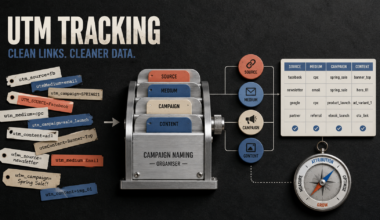
UTM parameters describe where a visitor came from. They may identify the source, medium, campaign, keyword, and creative variation associated with a visit.
Conversion tracking records what the visitor did after arriving.
For example:
utm_source=linkedinidentifies the traffic source.utm_medium=paid-socialidentifies the channel.utm_campaign=b2b-lead-generationidentifies the campaign.- A
form_submissionevent records the completed lead form.
Without UTMs, the business may record a form submission but struggle to identify the campaign that generated it.
Without a conversion event, the business may know that a campaign generated traffic but not whether those visitors completed valuable actions.
A clean campaign naming and UTM tracking system therefore strengthens conversion reporting.
6. Which Conversion Events Should a Lead-Generation Website Track?
A lead-generation website should track more than one action, but each event must have a specific meaning.
A practical event structure may include:
| Event | Purpose | Classification |
|---|---|---|
form_start | Visitor begins completing a form | Secondary |
form_submission | Form is completed successfully | Primary |
phone_click | Visitor taps the phone number | Secondary |
qualified_phone_call | Relevant call meets the business criteria | Primary |
whatsapp_click | Visitor opens a WhatsApp conversation | Secondary |
appointment_booked | Visitor confirms an appointment | Primary |
brochure_download | Visitor downloads a resource | Secondary |
qualified_lead | Sales team confirms lead quality | Primary |
customer_created | Lead becomes a paying customer | Primary |
A phone-number click is not necessarily a completed call. Similarly, a WhatsApp button click does not confirm that the visitor sent a message.
The event name and report should make this distinction clear.
7. Why Do Advertising and Analytics Reports Show Different Numbers?
It is common for an advertising platform, website analytics system, and CRM to display different conversion totals.
This does not automatically mean that one system is broken. Differences can occur because each system may use different:
- Attribution rules
- Reporting time zones
- Conversion windows
- User-identification methods
- Duplicate-handling rules
- Consent conditions
- Event definitions
- Date-of-click and date-of-conversion reporting methods
For example, an advertising platform may associate a conversion with an earlier advertisement interaction. A CRM may record the lead on the date the form was submitted. An analytics report may classify the same visitor based on the session that immediately preceded the conversion.
The objective should not be to force every platform to display an identical number. The objective is to understand why the numbers differ and establish which system will serve as the primary source for each business decision.
This distinction is an essential part of marketing attribution.
8. How Do You Prevent Duplicate and False Conversions?
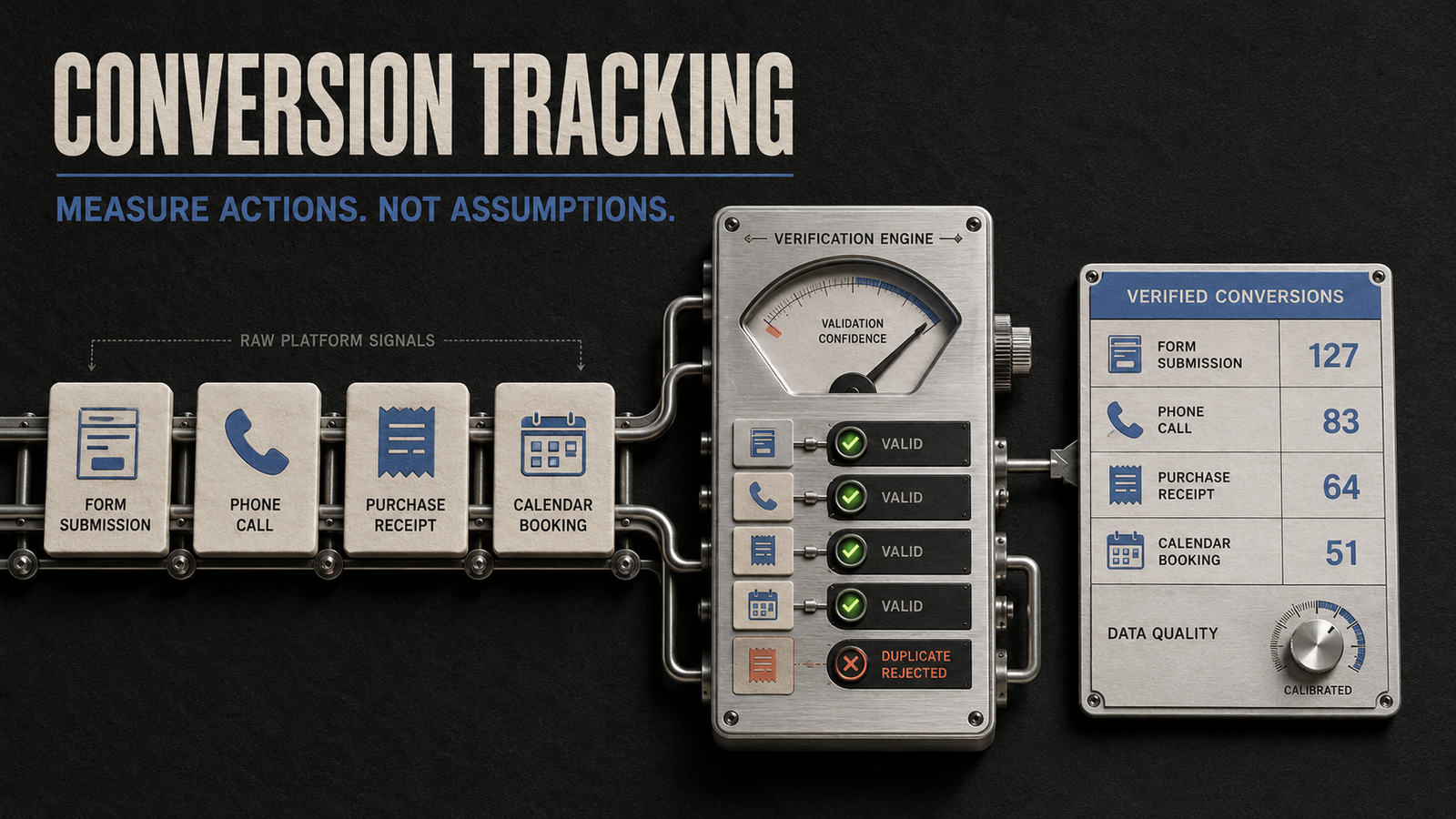
Duplicate events can make a campaign appear more successful than it is.
For example, a visitor may refresh a confirmation page and trigger the same conversion again. A tracking setup may also send one event through the website and another through a separate integration.
Common causes of inaccurate conversions include:
- Tracking both button clicks and successful form submissions as the same conversion
- Firing an event every time a confirmation page is refreshed
- Installing the same tracking code more than once
- Recording test submissions as genuine leads
- Counting repeated form submissions from the same person
- Treating every phone click as a completed call
- Importing the same CRM outcome multiple times
- Combining primary and secondary actions in one total
Every conversion event should have a clear trigger and a defined validation process.
Where possible, use a unique lead, transaction, booking, or event identifier. This makes it easier to recognize duplicate records and reconcile data between the website, analytics platform, advertising account, and CRM.
9. How Should Conversion Tracking Connect With a CRM?
Website analytics can show that a form was submitted. It cannot always show whether the lead was relevant, contacted, qualified, or converted into revenue.
That information usually exists inside the CRM or sales process.
When a lead is created, the business should preserve useful acquisition details such as:
- Original traffic source
- Original medium
- Campaign name
- Landing-page URL
- First conversion date
- Lead status
- Service requested
- Sales outcome
- Revenue or customer value
The sales team should then update the lead as it moves through the pipeline.
Possible stages include:
- New lead
- Contact attempted
- Contacted
- Qualified
- Appointment scheduled
- Proposal shared
- Won
- Lost
- Invalid or duplicate
This process connects conversion tracking with the lead follow-up system. It also helps the marketer understand whether a campaign is generating cheap leads or valuable opportunities.
10. How Can You Measure Lead Quality?
The number of form submissions is only the first layer of lead-generation performance.
A more complete analysis should measure:
- Total leads
- Valid leads
- Contactable leads
- Qualified leads
- Appointments or meetings
- Sales opportunities
- Customers
- Revenue
These figures can be used to calculate several useful rates.
Lead validity rate
Valid leads ÷ Total leads × 100
This shows how many recorded leads contain genuine and usable information.
Contact rate
Contacted leads ÷ Valid leads × 100
This helps identify whether the sales team is reaching the inquiries.
Qualification rate
Qualified leads ÷ Contacted leads × 100
This indicates whether the campaign is attracting the right audience.
Lead-to-customer rate
Customers ÷ Total leads × 100
This connects initial marketing conversions with final business outcomes.
This broader measurement approach prevents marketers from treating all leads as equally valuable. It also supports a more accurate evaluation of lead quality versus low cost per lead.
11. How Do Landing Pages Affect Conversion Tracking?
A tracking system can record behavior, but it cannot repair a weak landing page.
If visitors reach the page but do not convert, the problem may involve:
- A mismatch between the advertisement and landing-page message
- An unclear offer
- A slow or unstable page
- An unnecessarily long form
- Weak trust signals
- A confusing call to action
- Poor mobile usability
- Technical errors during form submission
Conversion data helps identify where the problem may exist.
For example, a high number of form starts combined with a low number of completed submissions could indicate that the form is too long, confusing, or technically unreliable.
A high number of page visits with very few form starts may indicate that the offer or page message is not persuasive enough.
Conversion tracking therefore becomes more useful when evaluated alongside a structured landing-page optimization process.
12. What Should You Test Before Launching a Campaign?
Conversion tracking should always be tested before advertising money is spent.
Use the following pre-launch checklist:
- Open the final campaign URL.
- Confirm that the correct landing page loads.
- Check that the required UTM parameters remain in the URL.
- Submit a test lead using clearly identified test details.
- Confirm that the correct conversion event fires once.
- Refresh the confirmation page and check for duplicate events.
- Verify that the lead appears in the CRM.
- Confirm that source and campaign values are stored correctly.
- Test phone, email, booking, and messaging links.
- Repeat the process on mobile and desktop.
- Check that internal team activity can be identified or excluded.
- Document the test and any issue that was corrected.
Testing should also be repeated after major website, form, CRM, or campaign changes. A tracking setup that worked previously can fail when the page structure or integration is modified.
13. How Do You Build a Reliable Conversion Measurement System?
A dependable conversion measurement process can be organized into seven stages:
- Define the business objective.
- Identify primary and secondary conversion actions.
- Create a clear event-naming structure.
- implement and test each event.
- Preserve campaign information using UTMs.
- Store leads and outcomes in the CRM.
- Compare campaign data with qualified leads and revenue.
This system creates a connection between the advertisement, website experience, lead, sales conversation, and final business result.
It also strengthens the broader full-funnel lead-generation strategy. Instead of optimizing one isolated metric, the marketer can evaluate how each stage contributes to the complete customer journey.
Final Thoughts
Conversion tracking is not simply a technical task completed before a campaign launches. It is the measurement foundation of digital marketing.
A reliable system clearly separates primary conversions from engagement actions, prevents duplicate events, preserves campaign information, and connects website behavior with CRM outcomes.
The goal is not to create the largest conversion total possible. The goal is to record the actions that genuinely matter to the business.
When conversion tracking, UTM naming, landing-page analysis, lead qualification, and sales follow-up work together, marketers can make decisions based on verified outcomes instead of incomplete platform numbers.
Before increasing a campaign budget, confirm that the tracking system is measuring the right actions correctly. Better optimization begins with better data.